5 – Solutions and Mitigation PLAN
Volunteer firefighter’s concerns and mitigation advisory committee
Kenny R, a volunteer firefighter with 37 years of experience, developed this plan. Read Bio click here.
I developed this website and plan to educate the citizens, elected officials, and paid administration about what is really happening in the volunteer fire service. I believe the only way to resolve this is with the citizens’ help and support. Remember, the volunteer firefighters are here for the citizens, but without the citizens’ support, there are no volunteer firefighters. I have lived a lot of these experiences that on this website tried to bring attention to local elected officials, but they did not even give me the time of day when I was a volunteer firefighter. They created roadblocks to shut us up but never came to the table to even listen to the concerns. Even though they have little to no training or experience in emergency response. Now, after 37 years of volunteer service, I have resigned. I’m bringing it to the attention of the citizens with possible solutions for the citizens. I continue to advocate for the volunteer firefighters at the local, state, and federal levels of government and the safety of the citizens they serve. Unfortunately, to this day I have been unsuccessful in having the local government come to the collaborative table even though the county I live in has the highest number of on-duty volunteer firefighter deaths in the state of New Mexico. I got my first training in firefighting in 1980 I received training in shipboard and aircraft firefighting by the US Navy. I learned that every sailor had some training in damage control and that is why even if our navy ships were hit, the sailors work as a team to get control of the damage; it did not matter what type of main job you had or your rank enlisted or officer it was all hands on deck to save the ship which in turned saved the lives of the sailors. Too bad all of us can’t come together and work as a team to provide the volunteer firefighters with a safe, non-hostile working environment. I got out of the navy and joined a volunteer fire department. Received training in structure firefighting and wildland firefighting. I became an adjunct instructor for the New Mexico State Fire Academy, then became a nationally certified instructor in Wildland and Incident Command. After several years of on the ground firefighting, I became an officer within the volunteer ranks up to assistant chief. On the Wildland side, I trained in ICS incident command and became a team member on national Type 1, 2, and 3 incident management teams. Which gave me experience not just with fires but hurricanes, large-scale sheltering for refugees, and the space shuttle Columbia recovery, traveling throughout the USA.
I had a great opportunity to work as a congressional staff member for our congressional representative. I learned uneducated policies affect the citizens of our county, and once they are in place, it is very difficult to change them.
So let’s all work as a team with respect to each other and give the volunteers a respectful place to do what they love and provide community service for life and property.
Kenny R
Retired volunteer firefighter.
No individual or single group should have the power to decide polices affecting the life, property, and environment of the community.
Our Mission is to have an sustainable fire and EMS service, no matter who the elected officials, city manager and fire chief are, their MUST be a Collaborative Effort with all concerned individuals, groups or parties.
Form a volunteer firefighter’s concerns and mitigation advisory committee.
Consider when communication blocks occur and/or policymakers cannot understand.
This happens when someone gets too much power:
- Blocks volunteer firefighters’ voices from being heard.
-
Blocks elected officials concerns from being heard by the volunteer firefighters.
- Speaks on behalf of the firefighters instead of allowing the volunteer firefighters to address their concerns in person. This allows for a mass interruption of the root issues.
- Doesn’t ask for advice from people who have experience as volunteer firefighters.
-
Turns real safety concerns into a personnel issue and does not address the root concern. And when things get terrible, it turns into “insubordination” and dismissal of the person bringing the concern to light.
Change who manages the volunteer fire department.
Pros:
- By placing the management of the fire department under the Volunteer Firefighter’s Concerns and Mitigation Advisory Committee. The volunteer firefighter concerns are heard and the committee will look for the root issue.
- The committee will address safety concerns in the community before action is taken.
-
The committee will interview all concerned individuals to determine whether this is a personnel issue or is there is an underlying root issue that needs to be addressed first, which may relieve the personnel issue.
-
Open collaboration between elected officials, paid administration, volunteer firefighters, and citizens.
-
Members of the advisory committee have experience as volunteer firefighters and they are trained in firefighter procedures and policies. This would be very valuable to the elected official to help understand the complexity of what volunteer firefighters face on day-to-day operations and provide for public safety.
If your local elected officials refuse to form a volunteer firefighter’s concerns and mitigation advisory committee.
- What are they afraid of?
- Don’t they desire a government that is transparent?
- Are they disregarding the safety of the citizens they serve?
- Are they disregarding the safety of the volunteer firefighters?
-
Are checks and balances on polices, monies received, monies spent, and monthly bank statements for public review important to the citizens?
-
Are they wanting their city/county manager to oversee everything, follow only the manager, and disregard input from firefighters or citizens?
- Are fire funds all accounted for and open to the public for review?
.
Volunteer firefighter’s concerns and mitigation advisory committee organizational chart.
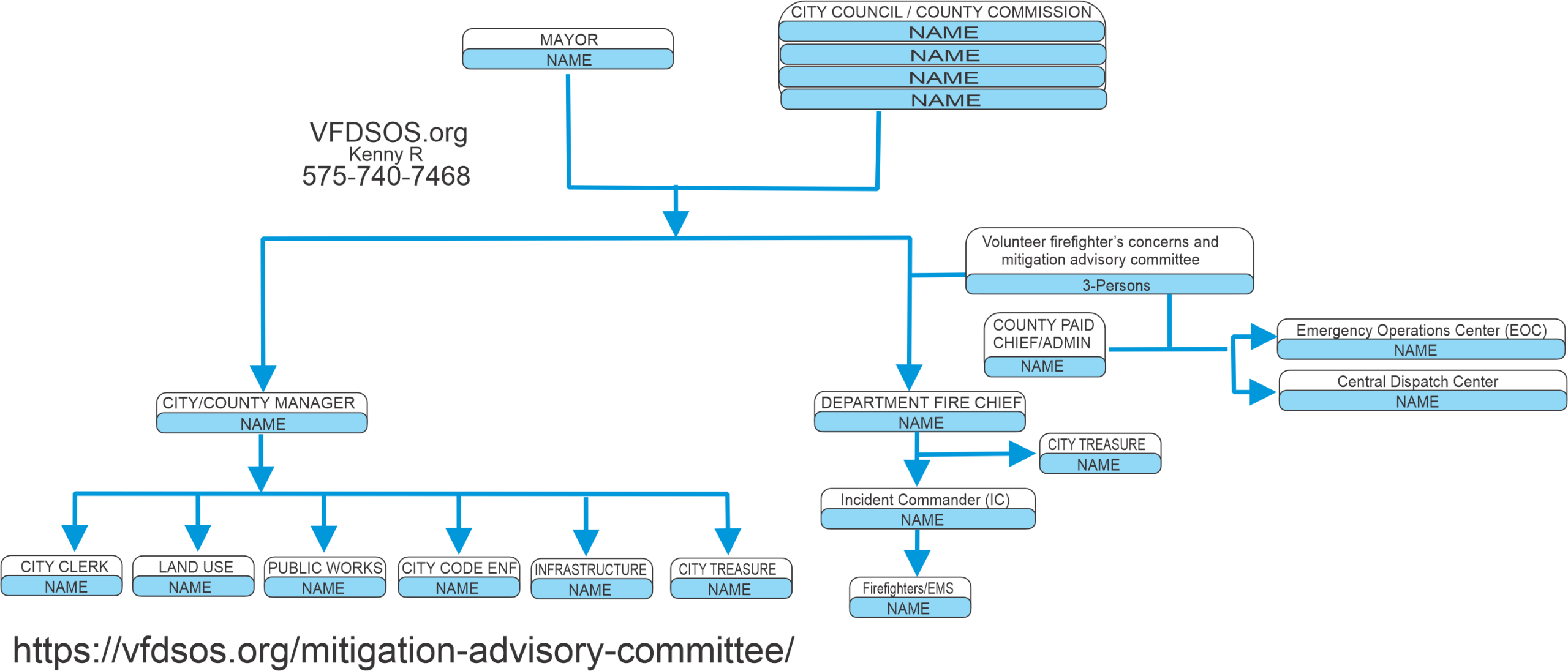
Local Government Type:
Council-Manager form of government, (New Mexico).
Where an elected City Council sets policy, and an appointed City Manager handles daily administration, hiring staff, implementing policies, and preparing the budget, blending political leadership with professional management. The Mayor and Council are policymakers, while the Manager serves at their pleasure, ensuring professional administration of city operations.
√ Means:
Checks and balances are so that no one person can make a major decision that could affect the life, safety, and property of the citizens within their community, encouraging local governments to have more information to make a decision that could affect the life, safety, and property of the citizens within their community.
Mayor’s Role /County Commission (Executive)
√ Recommendations:
- Consider the volunteer firefighter’s concerns and the mitigation advisory committee’s recommendation.
General Supervision:
- Oversees the Fire Department, often appointing the Fire Chief (subject to council approval in some cases).
Hiring/Firing:
- Recommends to the city council’s hiring and fire department personnel
- Should have a hearing with the Volunteer Firefighter’s concerns and mitigation advisory committee.
Budget:
- Prepares the proposed budget, working with the Fire Chief.
City Council’s Role /County Commission(Legislative)
√ Recommendations: Consider the Volunteer firefighter’s concerns and mitigation advisory committee recommendation.
Policy & Budget: Approves fire departments, authorizes positions, approves the budget, and sets overall policies.
Oversight: Receives reports from the Fire Chief on department status, fires, and losses.
Confirmation: May confirm the appointment of high-level officials, including the Fire Chief, depending on the city’s / county’s structure.
Volunteer firefighter’s concerns and mitigation advisory committee. (VFCMAC)
√ Establishing an open-door policy for all volunteer firefighters, citizens of the community, local elected officials, and paid administration can present a concern without fear of retaliation. Collaboration is required so that all parties address their concerns and suggestions.
√ Establish a website outside of local government control. To encourage transparency without the Freedom of Information Act being requested by an individual in the community.
√ Items to post on the website:
√ Bank Statement
√ Fire department budget
√All grants received, expenditures of funds, and status of grants for completion.
√Fire calls responded to and number of firefighters on each call.
√Total number of current firefighters and build a chart showing the increase or decrease in the number of firefighters.
Financial and administrative duties
√ Budgeting: Review annual budgets and strategic plans for the fire department.
√ Financial oversight: Audit claims, review financial procedures, and secure insurance.
√ Policy development: Review and recommend policies and rules to govern the fire department.
Strategic planning provides administrative oversight and reviews the long-term strategic direction for the district
√ Bank Account: All fire funds should be deposited in a separate bank account from the city’s general bank accounts.
Personnel management:
The VFCMAC recommends the person to be hired as paid fire chief. Approved by the City Council /County Commission members.
Volunteer firefighters vote on there volunteer fire chief and recommends the person to be. Approved by the VFCMAC.
The VFCMAC chief recommends fire officers for promotions. Fire officers approved by the Fire Commission.
Fire members vote to accept a new volunteer firefighter on probation.
Fire members vote to accept a probationally firefighter as a full member of the Fire Department.
Personnel Issues. The VFCMAC is to handle all issues with paid and volunteer personnel. Then send recommendations to the city council.
√ To conduct hearings and recommend discipline, including demotions.
Community and legal duties:
√ Public accountability: Inform the public about district matters and decide based on the needs of the community.
Compliance: Ensure the fire department complies with all state and federal mandates.
Intergovernmental relations: Work with other agencies on mutual aid agreements and other collaborations.
Emergency Operations Center (EOC)
- Primary Role: Coordinate resources and provide strategic support for the incident.
- Location: A centralized location away from the immediate incident scene.
- Responsibility: Broader support, setting jurisdictional objectives, and ensuring business continuity.
- Interaction: Supports the Incident Commander; communicates with the ICP and other agencies.
FIRE DEPARTMENT CHIEF:
√Reports to committee (monthly):
√Total number of calls and type of call. (itemized)
√How many personnel responded on each call.
√Expenditures of any fire funds for the month.
Fire Department Training Standards:
Development of fire positions within the department.
Set training standards and requirements for each fire/EMS position.
Development of support positions.
Set training standards and requirements for each support position.
SOG’s (Standard Operating Guide) and SOP’s (Standard Operating Procedures) for the department:
Take the current SOP’s and SOG’s for review.
Take input to update SOP’s and SOG’s
Keep SOP’s and SOG’ current.
Develop a guide for the fire department to update the SOP’s and SOG’s
Handling day-to-day command, training, equipment, and reporting to the council on departmental needs and performance.
CITY TREASURE
√ Bank Statement:
- Must be presented monthly to the City Mayor and Council, Volunteer Firefighter’s Concerns and Mitigation Advisory Committee, and Fire Chief
√Bank Account:
- All fire funds should be deposited in a separate bank account from the city’s general bank accounts.
-
Consider large grants over $300,000 to be in a separate bank account.
- Bank statements are to be published every month for public review.
√Fire Funds:
- The fire chief must sign for all expenditures of fire funds.
Compliance:
Ensures all fire funds financial activities comply with local, state, and federal laws and accounting principles.
Record Keeping:
Maintains accurate financial records of all fire funds, including receipts, warrants, and accounting for all funds.
Incident Commander (IC)
Primary Role: Direct, tactical management of the incident on scene.
Location: Incident Command Post (ICP).
Responsibility: Overall command, strategy, resource allocation, and management of all incident functions.
Interaction: Receives support from the EOC; communicates directly with the EOC Director for updates and resource needs.
Mayor’s Role (Executive)
√ Recommendations:
- Consider the Volunteer firefighter’s concerns and mitigation advisory committee recommendation.
General Supervision:
- Oversees the Fire Department, often appointing the Fire Chief (subject to council approval in some cases).
-
Hiring/Firing:
-
Recommends to the city Council’s to hire and fire department personnel,
-
Should have a hearing with the Volunteer firefighter’s concerns and mitigation advisory committee.
-
Budget:
- Prepares the proposed budget, working with the Fire Chief.
City Council’s Role (Legislative)
-
√ Recommendations: Consider the Volunteer firefighter’s concerns and mitigation advisory committee recommendation.
- Policy & Budget: Approves fire departments, authorizes positions, approves the budget, and sets overall policies.
-
Oversight: Receives reports from the Fire Chief on department status, fires, and losses.
- Confirmation: May confirm the appointment of high-level officials, including the Fire Chief, depending on the city’s structure.
Volunteer firefighter’s concerns and mitigation advisory committee
√ Establishing an open-door policy for all volunteer firefighters, citizens of the community, local elected officials, and paid administration can present a concern without fear of retaliation. Collaboration is required so all parties address their concerns and suggestions.
√ Establish a website outside of local government control. To encourage transparency without the Freedom of Information Act being requested by an individual of the community.
.√Items to post on the website:
- √Bank Statement
- √Fire department budget
- √All grants received, expenditures of funds, and status of grants for completion.
- √Fire calls responded to and number of firefighters on each call.
- √Total number of current firefighters and build a chart showing the increase or decrease in numbers of firefighters.
Financial and administrative duties
-
√ Budgeting: Review annual budgets and strategic plans for fire department.
-
√ Financial oversight: Audit claims, review financial procedures, and secure insurance.
-
√ Policy development: Review and recommend policies and rules to govern the fire department.
- Strategic planning: Provide administrative oversight and review the long-term strategic direction for the district
-
√ Bank Account: All fire funds should be deposited in a separate bank account form the city’s general bank accounts.
-
Personnel management:
-
Fire commission recommends the person to be hired as fire chief. Approved by the City commission.
-
Fire chief recommends fire officers for promotions. Fire Approved by the Fire Commission.
-
Fire members vote to except new volunteer firefighter on probation.
-
Fire members vote to accept a probational firefighter as a full member of the Fire Department.
-
Personnel Issues. The fire commissioners is in charge of handling all issues with paid
and volunteer personnel. -
√ To conduct hearings and recommend discipline, including demotions.
-
Community and legal duties:
-
√ Public accountability: Inform the public about district matters and make decisions based on the needs of the community.
-
Compliance: Ensure the fire department complies with all state and federal mandates.
- Intergovernmental relations: Work with other agencies on mutual aid agreements and other collaborations. —
Emergency Operations Center (EOC)
Primary Role: Coordinate resources and provide strategic support for the incident.
Location: A centralized location away from the immediate incident scene.
Responsibility: Broader support, setting jurisdictional objectives, and ensuring business continuity.
Interaction: Supports the Incident Commander; communicates with the ICP and other agencies.
CITY FIRE CHIEF
√Reports to committee (monthly):
-
√Total number of calls and type of call. (itemized)
-
√How many personnel responded on each call.
-
√Expenditures of any fire funds for the month.
Fire Department Training Standards:
-
Development of fire positions within the department.
-
Set training standards and requirement for each fire/ems position.
-
Development of support positions.
-
Set training standards and requirement for each support position.
SOG’s (Standard Operating Guide) and SOP’s (Standard operating Procedures) for the department:
-
Take current SOP’s and SOG’s for review.
-
Take input to update Sop’s and SOG’s
-
Keep SOP’s and SOG’ current.
-
Develop a guide for fire department to update the SOP’s and SOG’s
Handling day-to-day command, training, equipment, and reporting to the council on departmental needs and performance
CITY TREASURE
√ Bank Statement:
Must be presented monthly to the City Mayor and Council, Volunteer firefighter’s concerns and mitigation advisory committee, and Fire Chief
√Bank Account:
All fire funds should be deposited in a separate bank account form the city’s general bank accounts.
√Fire Funds:
The fire chief must sign for all expenditures of fire funds.
Compliance:
Ensures all fire funds financial activities comply with local, state, and federal laws and accounting principles.
Record Keeping:
Maintains accurate financial records, of all fire funds including receipts, warrants, and accounting for all funds.
Incident Commander (IC)
Primary Role: Direct, tactical management of the incident on scene.
Location: Incident Command Post (ICP).
Responsibility: Overall command, strategy, resource allocation, and management of all incident functions.
Interaction: Receives support from the EOC; communicates directly with the EOC Director for updates and resource needs.
Volunteer firefighter’s concerns and mitigation advisory committee,
Requirements to serve, SOG’s and SOP’s.
Overview
The Volunteer firefighter’s concerns and mitigation advisory committee will serve as an oversight for emergency services and public safety, with concerns for the volunteer firefighter and the public.
4 persons advisory committee
- Member #1&2 – Voting-Must have a permanent home within the city of _________________ boundary. Meet Common and Training Requirements.
- Member #3 – Voting- Must have a permanent home within the city of ____________ boundary or within the fire district. Meet Common and Training Requirements.
- Member # 4 a non-voting member, does not meet Common and Training Requirements. This person is to help the commission understand other views, other than firefighting. This is an advisory and visionary position.
- The Volunteer firefighter’s concerns and mitigation advisory committee. (VFCMAC) will NOT have a chairperson.
- The 3 voting Volunteer firefighter’s concerns and mitigation advisory committee. (VFCMAC) will work as a unified command. Which means all Volunteer firefighter’s concerns and mitigation advisory committee members are equal. The non-voting member will be an advisory position.
.
The method used to select Volunteer firefighter’s concerns and mitigation advisory committee members:
The mayor recommends a candidate for appointment to Volunteer firefighter’s concerns and mitigation advisory committee.
Candidates to be sent to the city council for final approval.
Common requirements:
- Permanent Home : Must be a legal resident of the city or fire district for a specific period (e.g., five years) and must spend at least 185 days per year in the home.
- Citizenship: Must be a United States citizen.
- Experience: Must have served a minimum of 10 years prefer 15+ as a volunteer firefighter on a volunteer fire department.
- Age: Must meet a minimum age requirement, such as 21 years old.
- Character: Must have good moral character.
- No conflicts of interest: May not be an active member of any fire department or receive a salary from any city, county, or NM State. Their spouse or significant other may not be employed by the City or County.
- Skills: While not a formal requirement for selection, commissioners are expected to understand financial matters, public relations, and have strong communication and organizational skills.
Experience (for voting members of the fire advisory committee):
- Experience (for voting members of the Volunteer Firefighter’s Concerns and Mitigation Advisory Committee):
- Must have served a minimum of 10 or preferred 15+ years or more as a volunteer firefighter on a volunteer fire department.
- Completion of the New Mexico Structural Firefighter Task Book or certification of Firefighter II or interdepartmental training to the same level to meet the task book.
- Preferred experience as an officer on a volunteer fire department.
Training requirements (for voting members of the fire advisory committee):
Required:
- Firefighter II Certification. (80 hrs) or state task book
- IS-100 or ICS-100 Introduction to the Incident Command System (2 hrs)
- IS-200.or ICS-200: Basic Incident Command System for Initial Response, ICS-200 (4 hrs)
- IS-700.B: An Introduction to the National Incident Management System (3.5 hrs)
- IS-800.D: National Response Framework, An Introduction (3hr)
- IS-908: Emergency Management for Senior Officials (1hr)
Suggested:
- IS-230.E: Fundamentals of Emergency Management (6hr)
- IS-235.C: Emergency Planning (5 hrs)
- IS-242.C: Effective Communication (8 hrs)
- IS-241.C: Decision Making and Problem Solving (2 hrs)
- IS-552: The Public Works Role in Emergency Management (2 hrs)
- IS-909: Community Preparedness: Implementing Simple Activities for Everyone (1hr)
- IS-906: Workplace Security Awareness (1hr)
- IS-915: Protecting Critical Infrastructure Against Insider Threats (1hr)
- IS-1024: Water and Wastewater Treatment System Considerations (3hrs)
- IS-1171.A: Introduction to the Risk Management Process (1hr)
- IS-1300.A: Introduction to Continuity (1hr)
- IS-2200: Basic Emergency Operations Center Functions (4hrs)
- IS-2901: Introduction to Community Lifelines (1hr)
The method used to select Volunteer firefighter’s concerns and mitigation advisory committee members:
-
?
Common requirements:
-
Permanent Home : Must be a legal resident of the city or fire district for a specific period (e.g., five years) and must spend at least 185 days per year in the home.
-
Citizenship: Must be a United States citizen.
-
Experience: Must have served a minimum of 10 years prefer 15+ as a volunteer firefighter on a volunteer fire department.
-
Age: Must meet a minimum age requirement, such as 21 years old.
-
Character: Must have good moral character.
-
No conflicts of interest: May not be an active member of any fire department or receive a salary from any city, county, or NM State. Their spouse or significant other may not be employed by the City or County.
-
Skills: While not a formal requirement for selection, commissioners are expected to understand financial matters, public relations, and have strong communication and organizational skills.
Experience (for voting member of Fire committee):
Experience (for voting member of Fire committee):
-
Must have served a minimum of 10 or preferred 15+ years or more as a volunteer firefighter on a volunteer fire department.
-
Completion of the New Mexico Structural Firefighter Task book or Certification of Fighter II or inter department training to the same level to meet the task book.
-
Preferred experience as an officer on a volunteer fire department.
4 persons committee:
-
Member #1&2 – Voting-Must be have permanent home within the city of _________________ boundary. Meet Common and Training Requirements.
-
Member #3 – Voting- Must be have permanent home within the city of ____________ boundary or with the fire district. Meet Common and Training Requirements.
-
Member # 4 NON-Voting member does not meet Common and Training Requirements. This person is to help the commission understand other views other the Firefighting. This is a advisory and visionary position.
-
The Fire committee will NOT have Chairperson.
-
The 3 voting Fire committee will work as a unified command. Which mean all Fire committee are equal. The non-voting member will be an advisory postilion.
Training requirements (for voting member of Fire committee):
Required:
-
Firefighter II Certification. (80 hrs) or state task book
-
IS-100 or ICS-100 Introduction to the Incident Command System (2 hrs)
-
IS-200.or ICS-200: Basic Incident Command System for Initial Response, ICS-200 (4 hrs)
-
IS-700.B: An Introduction to the National Incident Management System (3.5 hrs)
-
IS-800.D: National Response Framework, An Introduction (3hr)
-
IS-908: Emergency Management for Senior Officials (1hr)
Suggested:
-
IS-241.C: Decision Making and Problem Solving (2 hrs)
-
IS-552: The Public Works Role in Emergency Management (2 hrs)
-
IS-909: Community Preparedness: Implementing Simple Activities for Everyone (1hr)
-
IS-915: Protecting Critical Infrastructure Against Insider Threats (1hr)
-
IS-1024: Water and Wastewater Treatment System Considerations (3hrs)
-
IS-1171.A: Introduction to the Risk Management Process (1hr)
-
IS-2200: Basic Emergency Operations Center Functions (4hrs)